Kyverno exercises and solutions, in old and new format

Introduction
I have quite some certifications, also from the CNCF. Three of the CNCF certifications (CKAD, CKA and CKS) are exercises that you have to execute in an exam environment. This also means that the way I learn for these exams is different than the way I study for exams like KCA (Kyverno Certified Associate) that are multiple choice. And that’s a pitty: I missed the hands-on experience. But then I thought: what would I like to do with Kyverno? And then the idea for a list of exercises came up.
Different solutions for the same exercise
When I looked at the documentation of Kyverno, it turns out that Kyverno is in the middle of a change of the way specifications should be written: it turns out that CEL is the new standard and that there are new CRDs (Custom Resource Definitions) as well. Though the curriculum of KCA is two years old, it’s not clear if the CEL based way of working made it into the exam. And even if this isn’t the case, it’s always nice to work according to the newest best practices. I therefore wrote the answers to the exercises both in the old and in the new formats. I also wrote tests for all solutions. You can use the same minikube cluster for all the exercises.
Exercises
Okay, here they come:
Exercise 1: Installation
Installation and policy to change new namespaces:
-
Use Minikube to start a new cluster:
minikube start \ --profile kyverno-exercises-dev \ --cpus 2 \ --memory 4096 \ --cni cilium -
Install Kyverno 1.18.0 (or any other version that support both the old and the new formatting standards) on this cluster
-
Add the Pod Security Standards Kyverno templates to your cluster
-
When a new namespace is created, I’d like to automatically add
ResourceQuotaandLimitRangeresources to this namespace. (For this excercise, it doesn’t matter too much which values you use for the content of these resources) -
Forbid to create objects in the default namespace (for now, just scan on pods, services and deployments)
-
Try to create them both in the “old way” and the “new (CEL-based, based on new CRDs) way”
-
Create test sets for all Kyverno resources
Exercise 2: cost allocation
-
Create a validation policy that checks if the
comp.departmentannotation has valid values: it should be one ofict,sales,logisticsormarketing -
Create a validation policy that checks if the
comp.cost-centerannotation has valid values: it should be one ofCC0001,CC5020,CC7102orCC9000 -
Create a mutation policy: when cost center or department are not present, use the cost center and/or department of the namespace
-
Try to create them both in the “old way” and the “new (CEL-based, based on new CRDs) way”
-
Create test sets for all Kyverno resources
Exercise 3: help your security department
-
You have a certain bug that just accurs with nginx version 1.31. You’d like to get a list of pods or deployments that currently use that version of nginx. (The latest version of nginx is newer than version 1.31).
-
An employee that didn’t function too well thought: “let me please my colleages”. He added randomly annotations you_will_be_fired_too: “true” to different types of resources. You want a list of resources that have this annotations.
-
Try to create them both in the “old way” and the “new (CEL-based, based on new CRDs) way”
-
Create test sets for all Kyverno resources
Exercise 4: webhooks
-
Check all images that are used in your cluster with Trivy regularly (Assume that all resources are deployed using deployments)
-
Check if all images are verified, show one example that is and one example that isn’t verified
-
Show the Kyverno UI to see which resources are valid and which resources are not.
-
Try to create them both in the “old way” and the “new (CEL-based, based on new CRDs) way”
-
Create test sets for all Kyverno resources
Other challenges
- In the Dynatrace Community someone also made a challenge , Thank you Marina Pollehn for pointing me to the Dynatrace community!
Solutions
You can find the solutions to these exercices (except for the Dynatrace one, of course ;-)) in my github repo.
Some remarks:
-
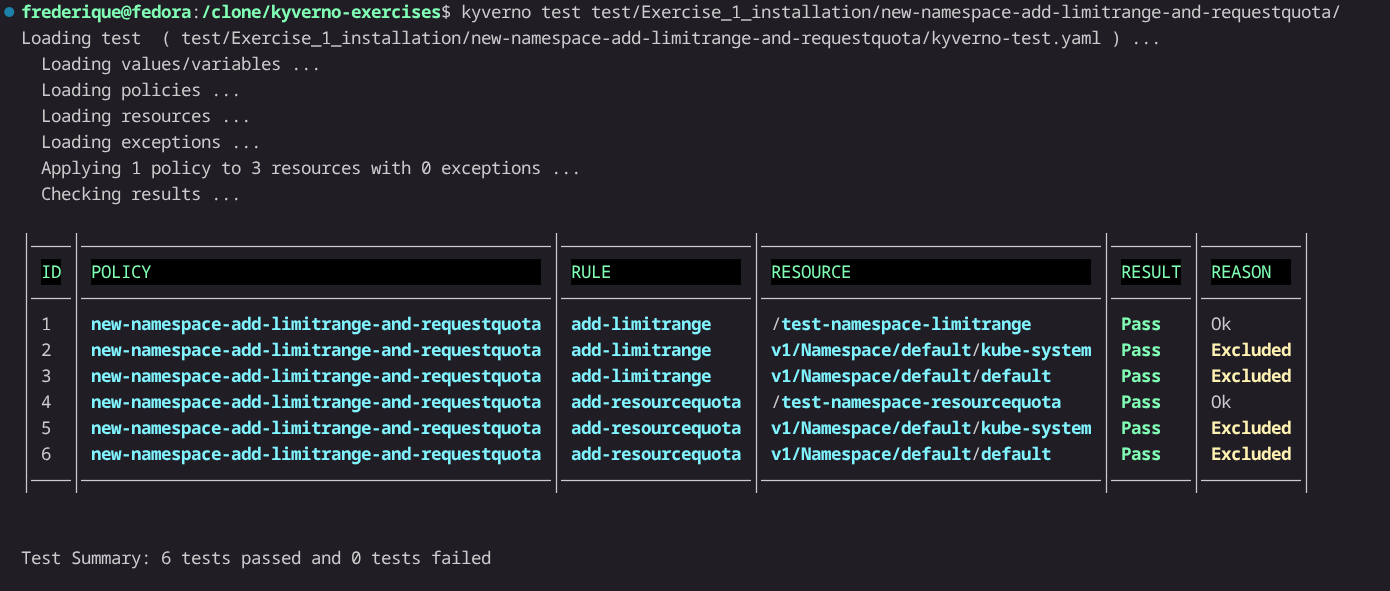
Exercise 1: When you use preconditions (like I did in the namespaces exercise) you can see in the output that the test passes, but the Reason is “Excluded”. It turns out, that you can put both “pass” and “skip” in the result of the test:
- policy: new-namespace-add-limitrange-and-requestquota
  rule: add-limitrange
  resources:
    - kube-system
  kind: Namespace
  result: skip   # pass is also allowed
Of course it is better to use skip here.
-
CEL vs non-CEL: in some cases the new way of working isn’t correct, for example in the tests for creating new resources for new namespaces. The mutation policy for the last exercise also doesn’t work in the CEL based variant (yet).